Showing posts with label Ramblings. Show all posts

Saturday, March 19, 2011

Fur

About a month ago, my parents told me about an animal that died on the edge of their backyard. They held off on investigating the death because of the massive snowfall at the time, and then kind of forgot about it. They noticed ravens tearing at the carrion, and time passed.

Then this past week I decided I should finally check out the remains (it could have been a neighbor's dog, after all). I fully expected to find a skeleton of some kind left over, but I found something quite different. Fur. Big clumps of fur. Some still attached to skin, but most just loose, and grouped into small carpets on the wet leaves. The snowbanks had clearly swept some of the hair down a small embankment against a stone wall left by farmers of yore, but the majority seemed untouched.

Curiously, there were no bones or any other remains to speak of. The scavengers were thorough. And though I thought the recent death would deter other wildlife from coming near the area, the site has become a frequent hangout for deer—as is evidenced by scat piles. This is partly due to my parents' hosta bushes which serve as a buffet when other vegetation grows scarce midwinter (much to my dad's chagrin).

I was at first sort of appalled by the fur. I found the remains disturbing because there was no other sign of the animal's former presence. But after a while I found it purely fascinating. As unsettling as it was to find the stray fur blanketing the forest floor, it was also strangely beautiful.

Friday, March 18, 2011

Art construction

Driving on Rt. 20 to my parent's house, I passed a vacant lot where a crew is building the foundation to a new house. What caught my eye is a series of impromptu decorations on the outskirts of the site. As if they couldn't help themselves, the men stacked the boulders they unearthed in the process of digging the foundation.
These stones are massive, and the largest definitely required heavy machinery to lift and position. Yet the workers still took the time to arrange the stones, presumably for the pure pleasure of doing so.

I think all of us have the capacity to be artists. It's the inexplicable urge to create that connects us.
 This is some cheesy stuff. Oh well.

Tuesday, March 15, 2011

Ornate labour

So I found these woodblocks at the Brimfield Antique Market in Massachusetts. Here's a website devoted to the sale of these blocks. It provides some information on their creation and use. The site listed above labels these blocks as having their origins in India, but the gentleman I bought them from told me these are from northern Pakistan. He also informed me that they range in age from 30- to 150- years old, the oldest generally being the more intricate pieces. The woodblocks are incredible just as objects unto themselves- gracefully and painstakingly carved treasures. I purchased them both as ornaments in this way and for their printing potentials. The first project I want to pursue with them is an illustration incorporating their patterns into the overall composition. I'll let you know when I've done something with them.


Tuesday, July 13, 2010

Terrestrial Locomotion

I often go running in the evenings here in Granby, CT- a town some of my friends believe to be the greatest on earth. No matter how hyperbolic their beliefs, the landscapes one encounters while out can make it difficult to disagree.
 
On one such bout I stumbled onto a number of adjectives spray-painted on the road. A couple of examples follow.
It's obvious that these words are meant as encouragement to whomever regularly cycles on that route, but the idea struck me as both bizarre and inspiring.

In honor of this benevolent graffiti, I'd like to pursue my own brand of vandalized optimism. Be on the look-out.

Friday, July 2, 2010

Bad Moon Rising

This is the first illustration I've finished in a long time. I'm hoping to break the hiatus by following this piece up with a couple of others in the coming two weeks, but we'll see.

I've posted below some of the process in its making, including the ink on acetate drawing, watercolor, an alternate coloring, and final touched up digitally (which is first.) The piece is approximately 8 x 10" (because my scanner can't accommodate much larger).

Final.
Ink on acetate.
Watercolor on paper.
Alternate Palette.

The idea for this piece appeared to me one night as I was driving home from a friend's house and noticed the moonlight spilling across a field.

I was nearly done with the piece before I realized that I was likely drawing subconsciously from an illustration in a book that I often read as a child. The book was published by Reader's Digest in South Africa (where I grew up until I was seven). It was a book of children's stories called: "The World's Best Fairy Tales." When I open the book now (I found it in my parent's basement) it falls open to the page with the illustration that so fascinated me. The illustration, pictured below, used to frighten the hell out of me for reasons I have trouble articulating now.
It depicted a scene from the story "Ntombinde Who Loved Adventure," a tale which to me defies categorization and analysis from Western standards. When re-reading the story today I thought at first it had a chauvinistic agenda, but by the end decided it was empowering in its feminism.

The story tells of a rebellious young Zulu woman who seeking adventure, ventures into the world and manages to get her village eaten by a monster for the reckless disobedience of her father. After everyone is freed by a crafty huntsman from the belly of the beast, Ntombinde's father makes her promise not to do any more adventuring and to settle down and marry. Ntombinde thwarts her father's intentions once more by agreeing to marry only if she can choose her husband (apparently an unusual request).

Ntombinde chooses the Snake Man who lives in a village nearby, a creature whom everyone fears. By her fearless acceptance of him as her husband despite his slithery form, Ntombinde breaks the curse on her soon-to-be-spouse. The Snake Man had been transformed into a serpent by his jealous brothers, as he was to take his father's place as chief. Ntombinde then marries the Snake-man-turned-handsome-chief and lives a happy, wealthy life. I have trouble drawing a single moral from the narrative, but the message seems to be: fate will reward those who are courageous and persevere despite initial obstacles.

Anyway, it wasn't the story that interested me when I was younger- it was the illustration. I think to a large extent the bizarre dentistry of the beast disturbed me- the ratio of gums to teeth seems disproportionate. There's no real point in analyzing the illustration's effect on me since quite nearly everything had the potential to scare me when I was younger. Still, I was amazed that it should find its way into some of my work.

I was listening to a radio program (actually a podcast) called Big Ideas- a Canadian produced (TVO) lecture series that's well worth investigating- it's on iTunes. The speaker of this particular episode Cory Doctorow, was arguing for the continued publication of books despite the seeming trend toward digitized versions of books and infringing copyright laws. His rationalization seemed overly romantic (and frankly, materialistic) to me at first listen, but after finding "The World's Best Fairy Tales" in the basement, smelling its pages and reminiscing with my gran I have definitely changed my mind.

I wish for everyone to find a crappy old book they can leaf through and rekindle some childhood fear or fantasy.

Tuesday, June 29, 2010

Sticky Situation

Lately it feels like life will always be hectic. I do my best to be at peace with the maelstrom of lists and obligations, but sometimes I find it all very overwhelming. Beer can be a good medicine but it's no antidote for the source of the problem. And damn, post-it notes are expensive! Thank God for Google documents and digital calendars and the like. 
An illustration of my frustrations below:

Monday, June 28, 2010

The Peachy Cosmos

While chatting with my family after breakfast last week, my gran and I sat marveling at the complex patterning of some peaches on the table before us. I set out to document the sight to relay how much the surface resembled pictures I recalled seeing taken from the Hubble Space Telescope.

When actually comparing the universe to the fruit the resemblance isn't so impressive...go figure. As you can see below, the images of the universe appear far brighter and more intense than that of the peach and nectarine skin.

Nevertheless, the peaches continue to wow me. All images of the universe are from the Hubble Space Telescope and can be found on this site: http://hubblesite.org/

Friday, June 18, 2010

The Hermaphrodite with Nine Hearts

I stepped into the garden on Tuesday with a borrowed macro lens- an enlightening experience.

The petals of nascent daisy buds were like silk ribbons carefully woven together.


I watched with crazy clarity as bumblebees burrowed into flowers.


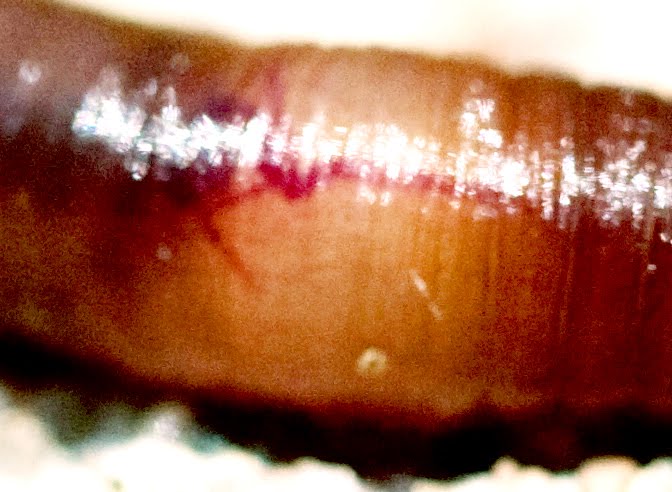
With this powerful new perspective I discovered a tiny tragedy on the pavement. Worms forced out of the soil by recent rain had been stranded to bake in the sun. From my regular height the worms' situation didn't seem so dire, but through the macro lens they were clearly dying.


One of the most amazing aspects of this performance were the veins that were visible beneath the skin of the earthworms. In the sequence below you can see the aortic valve propelling blood into the segment of the worm closest to the camera. To me the violence of this pumping was the surest sign of the worm's imminent demise.


Before I'm accused of animal cruelty, let me say that I did everything I could for all of the worms I could find in the parking lot after I had taken a minute or so to document them. I'm confident I saved at least a few.

This isn't the first bout of compassion I've felt for an earthworm. In high school I produced a small project to commemorate their constant solar-induced deaths. The point I guess was to focus on the microcosmic theatre that plays out all around us without our slightest knowledge.

It seems important to point out that I had a sense of humor about the whole thing. At the same time, it reminded me that death is just as much a surety for you or I as it is for an earthworm.

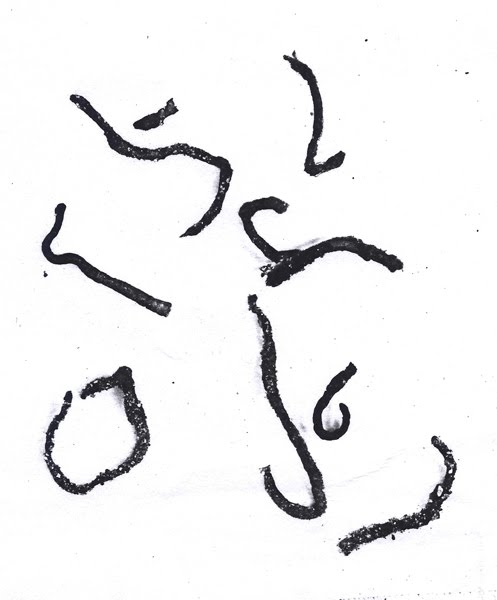
It seemed to make sense anthropomorphizing the worms. I made xerox transfers of their carcasses and produced a small dry-point etching (which I have since misplaced). I managed to find the sketch for the print buried in my basement- it's pictured below.


Looking back I'm not sure exactly what I wanted the xerox transfers to communicate, but as I see them now it appears as if the worms are disintegrating, or perhaps petrifying- to be remembered like mummies. I guess that's how I see a lot of my work, as a record, like a mummy or a time capsule- a way to preserve the mutable. Perhaps a fitting illustration of this concept is the self portrait I made as a mummy during a printmaking class at RISD, which can be found at my website:


Even such is time, which takes in trust
Our youth, our joys, and all we have,
And pays us but with age and dust;
Who in the dark and silent grave,
When we have wandered all our ways,
Shuts up the story of our days;
And from which earth, and grave, and dust
The Lord shall raise me up, I trust.

I don't trust as much to faith as Sir Walter Ralegh (whose "Author's Epitaph" to "Nature, That Washed Her Hands in Milk" is quoted above) did, but for me it eases the fear of the unknown to memorialize moments of my life, and that of others (and worms) through pictures.

Worms, by the way, get a bad rap in 16th century British poetry- they're always eating people in their graves. Andrew Marvell used worms as a means of convincing his mistress to part ways with her chastity in "To His Coy Mistress":

Thy beauty shall no more be found,
Nor, in they marble vault, shall sound
My echoing song: then worms shall try
That long-preserved virginity,
And your quaint honor turn to dust,
And into ashes all my lust:
The grave's a fine and private place,
But none, I think, do there embrace.

That Marvell had a wild and dirty imagination, but he certainly had not studied his worm facts. He should have known better than to soil the reputation of the annelid- highly asexual creatures. Perhaps contemporary poets could learn from Marvell and pick on someone their own size when trying their game with the opposite sex.

The earthworm project was partly a response to a piece of poetry produced by a teacher I had at the time. She wrote a piece inspired by earthworm anatomy. Earthworms, she told us, possess nine hearts; hence the number of worms in the xerox print above.

I have since found that this is not entirely true- worms have aortic valves that supply oxygenated blood to their segments. It sounded too romantic anyway. As I pointed out for Andrew Marvell above, earthworms are terribly unromantic. They all possess both male and female sexual organs. And besides, a moving intestinal tract can't be expected to woo too much.

Still, the worm poem got me thinking enough to produce the project at the time. Now that worms are back in my mind I'm thinking of making a huge print of one of the earthworm shots. It could serve as a reminder of the mind-boggling diversity of infinitesimal life that carries on always and everywhere.

For those interested in other worm facts: http://urbanext.illinois.edu/worms/facts/index.html

This post is ridiculous.